






Though many modern-day commentators hark back to an age when British politics was less hostile and more respectful, they are clearly unaware of the type of behaviour exhibited at the Victorian political hustings which occurred in Southwark, writes Neil Crossfield…
In November 1830, the Maidstone Journal & Kentish Advertiser reported on the Southwark Hustings, where Thomas Farncomb was competing against wealthy brewer, Charles Calvert, to become MP for Southwark. Farncomb and his supporters set out from the George Inn, led by a band of musicians and ‘accompanied by a shouting multitude.’
These supporters had been jeered by Calvert’s supporters on their way to the Town Hall. Quite soon after the speeches had been made, the supporters began throwing mud at their opponent’s banners. Farncomb had the support of burly coal heavers on his side who soon gained the advantage and pushed their way through, taking control of the area in front of the hustings.
Despite attempts by both candidates to calm the situation, the violence intensified, with the mob using cudgels and ‘throwing brickbats in whisps of straw’ to attack each other. Windows in nearby shops were smashed and many people were injured. The casualties were taken to Guys Hospital, and it is reported that at least one person may have died in the violence.
Some sort of order was restored when constables at the incident drew their swords, but luckily, they did not use them. This was only eleven years after the infamous Peterloo Massacre in Manchester, so those involved in the rowdy behaviour would no doubt of been aware just how quickly it could be for disorder like this to get out of hand.
Apart from the candidates, large numbers of journalists would be present on the hustings, reporting the events which would then be printed at great lengths in their newspapers. Using shorthand, they would note word for word what was said, even including when the crowd cheered or booed the speaker.
It should be remembered that these large hustings were taking place before the introduction of amplification and loudspeakers, so the record taken by the journalist was often the only way people might find out what the speaker had said, such was the noise.
Family members and other supporters would often join the men on stage, bedecked in the colours of the political party their man was standing for.
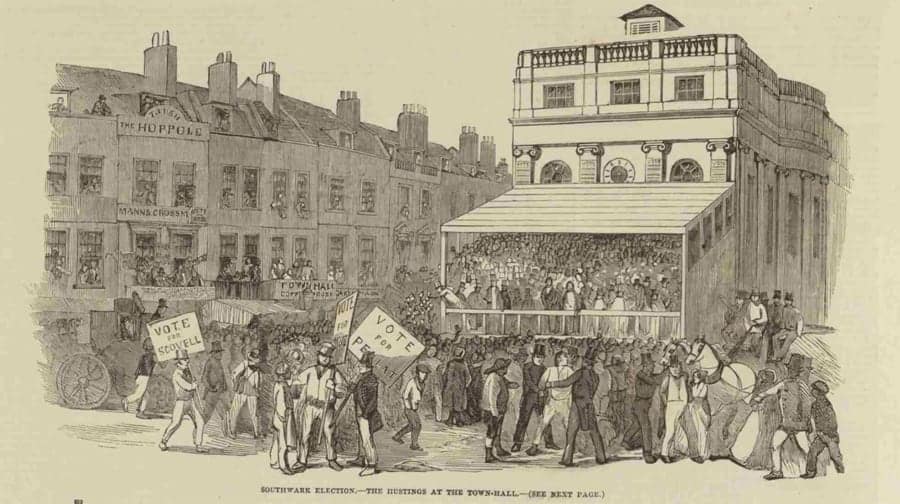
The Illustrated London News on 10 July 1852 printed sketches made of hustings taking place at Lambeth, Greenwich and Southwark (see main picture above).
Relatedarticles



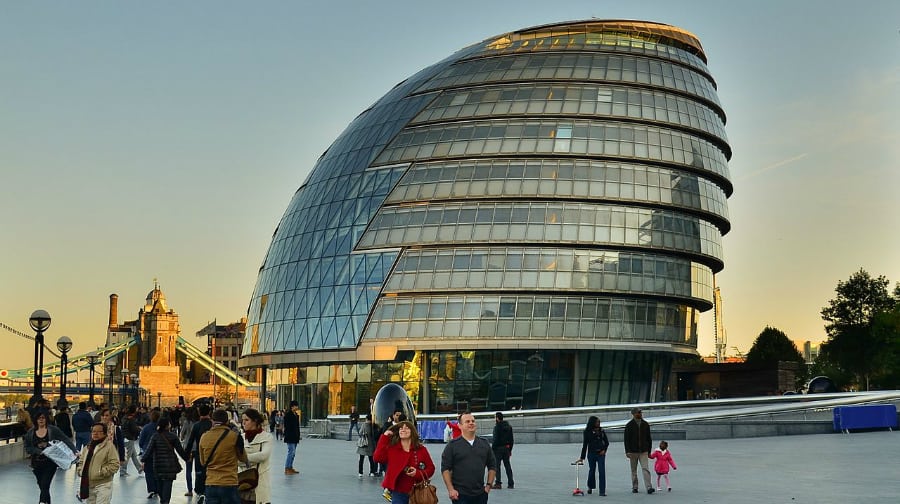
A large hustings platform had been erected at the front of Southwark Town Hall on Borough High Street. The Morning Chronicle newspaper reported that nearby shops were closed, and people stood at open windows watching the proceedings. A crowd of up to 400 gathered in front of the town hall, whilst people passing by on omnibuses strained to hear what the candidates were saying.
Southwark Soapbox: are low traffic neighbourhoods really worth the hassle?
In 1857, noted French novelist Alexandre Dumas was visiting England and wrote about his experiences visiting the Southwark Hustings that year. Approaching the meeting in a carriage, he estimated that a crowd. some 4,000 people, had assembled in the street, making it necessary for him and his companions to push their way through the group. Being a distinguished writer of some fame, he was invited up onto the husting structure to meet the candidates, where he was cordially greeted by all.
The owner of a local glass factory, Mr Apsley Pellatt, was standing again after being unsuccessful in 1852. His opponents were the sitting MP, Admiral Sir Charles Napier, naval hero and the eventual winner, John Locke of the Liberal party. Dumas describes the abuse Pellatt received from the crowd when he addressed them, “he intended to speak, but the thunder of heaven would have struggled in vain against the human thunder from below.” Eventually giving up, Pellatt turned his back on the crowd and finished his speech to the journalists sitting on the hustings.
Earlier that day he had attended the hustings at the Guildhall and had remarked on the silence and order of the crowd there, “that was on account of their new law on bribery, for it is not even any longer allowed to make the electors drunk.” He was referring here to the 1854 Corrupt Practices Act. Bribery and corruption had been rife in the British electoral system, with candidates trying to elicit support either by paying people to vote for them or by plying them with free food and alcohol.
Southwark Soapbox: should the council scrap the bulky waste charge to stop fly-tippers?
The West Kent Guardian writing in 1854 about the government’s attempt to counter election corruption noted that “Barclay and Perkins, Truman, Hanbury and Co exercise a magic influence upon the state of political parties.” While not all bribes were so overt, candidates could influence voters by spending huge amounts of money in a campaign: engaging local tradesmen to produce banners and ribbons, employing canvassers and agents. Even payment for the construction of the husting platform might ensure a vote from the grateful builder.
Large donations to local charities could be made and some wealthy MPs even built hospitals or libraries. Laws may have curtailed bribery, but people always seem to find a way to get around them.
In 1880 Reynold’s Newspaper reported that Mr E Clark had been returned as MP for Southwark and it was widely known that many of his supporters had received copious amounts of free liquor in local pubs, with the landlords conveniently ‘forgetting’ to ask for payment to circumvent any accusation of bribery. While a desire for public service and political change were necessary attributes for prospective MPs, deep pockets were an even more vital quality.
Though attempts had been made to civilise these events, candidates would continue to use underhand methods to disrupt their opponents. In 1868 the Hustings at Southwark were attended by a crowd of over 3,000 people. Newspapers reported that the Conservative candidate, Alderman Cotton, had engaged the services of workmen who had been placed in vans next to the stage. When the Liberal candidate, Locke, began to speak, the men jeered loudly drowning out his words. Though he denied he had paid these men, his protestations of innocence were put in doubt when the men started producing banners supporting Cotton. The police were eventually summoned to pull the vans away.
Southwark Soapbox: residents shocked at ‘astonishing’ lack of youth services in Newington ward
The role the Hustings had previously played in the electoral process was diminished on the introduction of the Secret Ballot Act of 1872.
As we have seen, electoral candidates would often be local businessmen or landlords and a person who was seen to be voting against their employer or landlord risked the chance of being dismissed or evicted from their home. Malpractice was common and unscrupulous candidates were sometimes known to employ ‘heavies’ to circulate within the crowd at hustings to make sure that people voted for the ‘correct’ person.
The 1872 Act saw the introduction of the polling booth meaning that voters could choose freely without fear of intimidation as their vote would now be secret. The Hustings did not totally disappear but evolved into an arena where constituents could come face to face with those standing for office. While we are now familiar with the concept of the televised leaders debates during election, few now remember that the origin of these can be found in the Hustings.
The history of hustings, where even dead cats were thrown at candidates
On 5th May 2022, local elections are scheduled to take place throughout the United Kingdom. All 32 London boroughs, including Southwark, will vote to decide who will hold political power for the next few years. In the period leading up to the election, many residents can expect to receive leaflets from the various political parties through their letterboxes or they may even be fortunate enough (or unfortunate depending on their views!) to have one of the candidates knocking on their front door, canvassing for their support.
We can expect to see party political broadcasts on our TV sets and no doubt our social media feeds will be full of promotional material put out by the assorted parties. Yet these forms of canvassing are relatively recent.
In the 18th and 19th centuries, one of the most popular ways in which prospective candidates would try and gather support was by appearing at a large public meeting called a Hustings. Originally developed from the Old English word h?sting or the Old Norse h?sþing, its literal translation is “house thing” or “house assembly”. These were judicial assemblies where Anglo-Saxon kings and their follower’s held council and resolved civil disputes.
As the British political system evolved, Hustings became a vital part of the democratic process, becoming the place where candidates would have to face the electorate. Before the great electoral reforms which took place in the 19th century, politicians were largely drawn from the wealthy or aristocratic classes, who generally had little interaction with the public. However, as the franchise expanded, rival candidates were required to attend nomination hustings as part of the election procedure. Once they had been through a formal process of nomination and had delivered a speech to the crowd, a vote by show of hands was taken. The losing party would then request a formal poll to be taken, in which only those on the registered list of voters could participate. Prior to the later reform acts, only a relatively small number of adult men were enfranchised and consequently many of the people present at the husting would not be eligible to vote. Despite this, the hustings allowed the public to indicate their support for candidates.
The term hustings also referred to the raised platform from which the candidates could speak to the crowd. Large numbers of people would gather at these public meetings, meaning that the hustings had to be substantial structures to elevate the candidates above the masses.
The hustings were a chance for constituents to observe, challenge and size up the candidates. They could be riotous, raucous affairs, often leading to outbreaks of violence. Heckling was commonplace and displeasure was shown by the throwing of cabbage stalks, rotten eggs and even on occasion, dead cats.
In an age where the general population had little opportunity to interact with their political masters, the hustings provided a chance for some form of political levelling. A candidate, whatever his social rank would have to face the mob. It became a rite of passage for British politicians whose mettle would be tested facing the crowds. They were expected to deal with the ’rough music’ and abuse with grace and good humour. Those who couldn’t deal with the rough and tumble of the hustings would no doubt have found the adversarial atmosphere of the House of Commons difficult.