



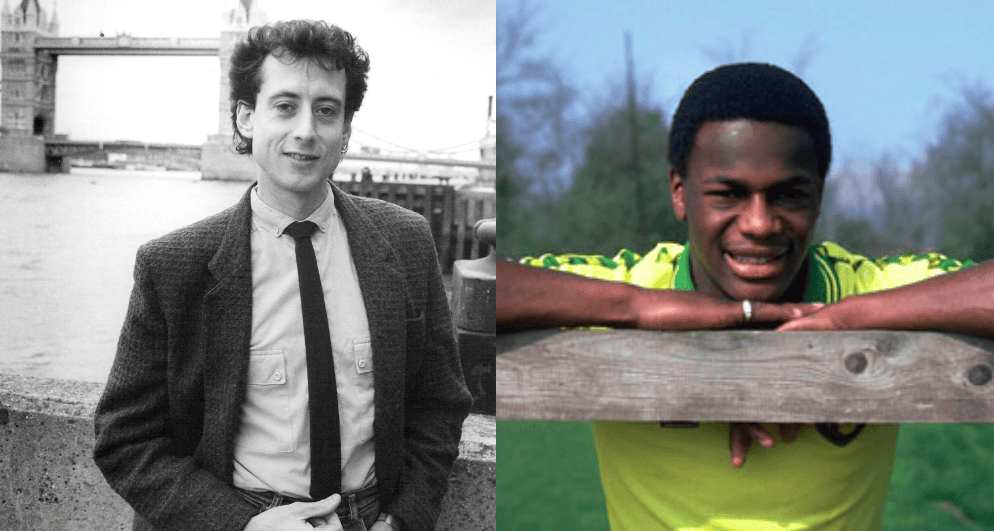
Forty years on from the notorious Bermondsey by-election that was marred by homophobia, Peter Tatchell has spoken about his secret love affair with gay footballer Justin Fashanu and the appalling abuse he suffered.
Fashanu’s tragic end came in 1998, after he took his life following a series of allegations made against him over a sexual relationship he had with a seventeen-year-old in the United States.
The relationship he shared with one of the UK’s most outspoken gay activists has been unknown until now. Tatchell’s bid to be MP for Bermondsey was beset by a level of homophobic violence and intimidation not seen before or since.
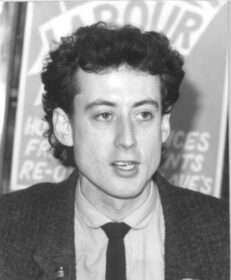
Some commentators say the media and political campaigns against him, including from his own party, represented the most sustained vilification of a gay public figure since Oscar Wilde.
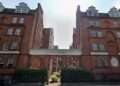
During this tumultuous time, Tatchell says the young footballer would visit his council flat in Elephant & Castle as the pair were forced to hide their relationship.
Tatchell said Fashanu would “crawl from the stairwell” to his front door, “reckoning that even if someone spotted him coming into my block they wouldn’t know which flat he went to”. He said their relationship ended due to distance, with Fashanu living in Nottingham.
At the time Tatchell says the paparazzi had laid “siege” to his Rockingham Estate flat. Despite all this, he says the press council refused to intervene.
A glimmer of joy in Tatchell’s life during that period was his alleged relationship with Fashanu. Justin Fashanu came out in 1990 but he was in the closet when the pair met over a decade earlier at the gay nightclub Heaven.
Relatedarticles


It was ‘a relationship of love’ according to Tatchell – one painstakingly concealed to avoid ruining Fashanu’s career, which was not helped by Nottingham Forest manager Brian Clough.
“We had a lot of discussions about his very difficult high pressure situation and his manager Brian Clough was abusing him after receiving reports he’d been seen at gay clubs. It’s no coincidence that Justin’s performance on the pitch deteriorated. He didn’t feel welcomed or accepted by Brian Clough.”
Man who built a house in a skip is receiving a warm welcome from his new neighbours in Bermondsey
Tatchell told the News how he endured terrifying attacks during that time as he battled for votes on the campaign trail.
“I had over 150 attacks during the run up to the campaign including 30 attacks on my flat – mostly bricks and bottles through the windows – but also an arson attempt and a bullet through the letterbox,” he said.
On two occasions, Tatchell says, vans tried to run him over on Lower Road and Great Dover Street, with one collision swiping him and his mangled bike into the gutter.
The infamous ‘Battle of Bermondsey’ was a time of political reckoning for the Labour Party locally and nationally and ultimately ended with Simon Hughes winning the seat to the shock of the nation, and Margaret Thatcher winning a landslide victory for her second term of office.
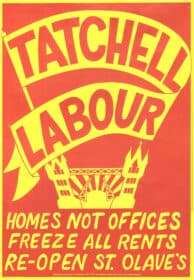
Labour leader Michael Foot faced internal revolts over the party’s drift to the left. In many ways, Peter Tatchell was a symbol of that drift – a young, openly gay Australian activist advocating for a minimum wage, anti-discrimination law and opposing private development in Bermondsey.
On a local level, Peter set out a vision of transforming the industrial Bermondsey docklands into an urban garden city. This, he says, would mean houses with gardens and trees in every street and pocket parks.
He had already, as chair of the Rockingham Estate tenant’s association, mobilised local children to march on the Greater London Council to demand that the derelict Dickens Square be turned into a local park with an adventure playground for kids.
He says houses with gardens was his battle cry in an area where tenants were being forced into concrete blocks like “battery chickens”.
He also called on Southwark Council to decentralise its services, especially housing, to dozens of local hubs, to make them more accessible and accountable to local people.
In particular, he wanted to improve the speed and efficiency of council estate maintenance and repairs.
Since 1946, Labour MP and former docker Bob Mellish had represented the Bermondsey constituency. But according to Tatchell, he had presided over a stagnation of the local party.
“Hardly anybody attended local branch meetings. The party had almost no connections with local community groups and it did no campaigning. It was just a shell,” said Tatchell.
He added: “The community was up in arms against the Labour council’s plans for a luxury town hall and its collusion with property developers who wanted to take over the area to build office blocks and luxury flats.”
By 1981, the Bermondsey Labour group was being run by the new left-wing faction of the party, with Tatchell as their secretary. When Bob Mellish announced he was leaving the party to join the London Docklands Development Corporation (LDDC) in 1982, Tatchell was chosen as his successor.
The LDDC was introduced by the government to convert the industrial wasteland of Bermondsey and east London after the collapse of the docks. The east end would be home to Canary Wharf – the second city of London. Rotherhithe would provide the homes and whole swathes of new offices and luxury flats would be built on Bermondsey’s riverside.
Exclusive: Woman found dead in ‘swamp’ flat ‘lay there for roughly four months’
It was Bob Mellish’s resignation that prompted the notorious by-election the following year, with Tatchell keeping his candidature despite opposition from leader Michael Foot.
Arguably the most horrifying vitriol Tatchell faced came from his own party. Outgoing MP Bob Mellish backed rival Labour candidate and Southwark Council Leader Paul O’Grady. Tatchell said O’Grady would parade around in a horse-drawn cart singing a homophobic ditty in the election run-up.
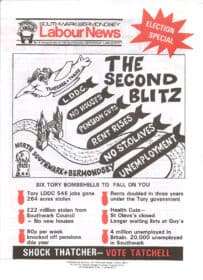
The Liberal Party or the Alliance as it was known at the time, represented by Simon Hughes, handed out campaign material saying the election was ‘a straight choice’. Canvassers would wear lapel badges saying ‘I’ve been kissed by Peter Tatchell’.
All this was against a backdrop of anonymous graffiti by the far-right declaring Tatchell was a ’n*gger lover’ and ‘communist p**f’.
Simon Hughes said the canvassers did so without the knowledge or authorisation of organisers and were told to remove them once organisers saw them.
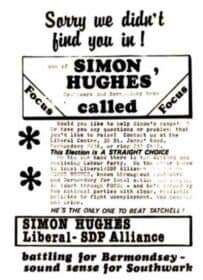
Sir Simon Hughes, who went on to win the election and serve as MP until 2015, would come out as bisexual in 2006. He has since apologised to Tatchell for his treatment by members of the Liberal Party, though he says he knew nothing of it at the time.
Simon Hughes said: “We’d been working in the constituency solidly for over two-and-a-half years before the by-election and had been building up our strength and success in the ‘81 and ‘82 elections. After the by-election, we went on to hold the seat for a further seven elections including with a bigger majority in 2010 on the last occasion and it was a privilege to do that. Whatever the circumstances that can be regretted about 1983, I hope in as many ways as possible that I and my colleagues have made up for anything that may have been inappropriate back then.”
Tatchell said: “I can understand why Simon Hughes wanted to remain closeted about his bisexuality during the campaign but that does not excuse the Liberal Party’s homophobic leaflets.”
The Labour vote totally collapsed and the Liberal Party swept to a landslide victory, taking the red stronghold with 57.7 per cent of the vote. Peter Tatchell says the loss was a homophobic protest vote, but that his policies were also misrepresented.
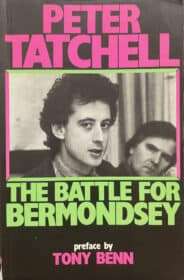
Reflecting on how society has changed since 1983, Tatchell said: “There have been huge changes for LGBT+ people since the Bermondsey by-election, both in terms of law reform and public opinion. Now it’s easy for a gay candidate to get selected by their parties and win elections.
“After the Bermondsey by-election there was huge public revulsion at the homophobic abuse I received. A lot of people were guilty and ashamed and that meant that subsequent gay candidates were not demonised like I was.”
But he also noted how, much like in 1983, a Labour Party political establishment was appearing to block left-wing candidates. “The leadership is still trying to impose candidates and override the local democratic selection processes of local parties,” he claimed.
A documentary about Peter Tatchell’s 56 years of campaigning ‘Hating Peter Tatchell’ is available on Netflix.
The story of Peter Fashanu’s life is also being adapted into an ITV drama, written by Bafta-nominated Young Vic director Kwame Kwei-Armah.