








Passengers claiming compensation over delays on trains run by Govia Thameslink could reach a million, just weeks before to being nationalised, writes Rich Brann…
The London-based operator has received more than 800,000 compensation claims so far this financial year, putting them at serious risk of seeing over a million claims in 2025-26.
According to statistics from the Office of Rail and Road (ORR) it would mark the worst year for delay claims since the pandemic and the 2018-19 disastrous rollout of a new timetable, which led to a whopping 1.6 million compensation claims. On that occasion the company faced a £5 million fine, and an independent inquiry criticised the operator. It is the largest train operator in the country, running services across South London and as far north as Cambridge and Bedford.
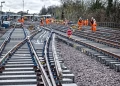
However, Thameslink have maintained that a rise in passenger numbers by 6% in the past year, alongside significant instances of trespassing and engineering failures outside of their control, helped explain this rise in passenger dissatisfaction.
Louis Rambaud, Chief Customer Officer, Govia Thameslink, said: “Over the rail year 25/26, we saw a slight increase in Delay Repay claims compared to the previous year, which reflects the increase in journeys being carried out across the GTR network…we encourage customers to claim for any delay they experience of 15 minutes or more and payments are made even when the root cause is completely outside of our control.
“Whilst our ratio of complaints is well below the industry average, we know that any delay to a service, whether big or small, has a huge impact on our customers – that’s why we’ve taken sustained action to strengthen how we plan, resource and run our railway, resulting in fewer cancellations and improved punctuality.”
The operator is due to be nationalised next month, transferring into the hands of the government.
The last two months of 2025 left most UK passengers worse off overall for delays, with 13% more train travellers making a claim for money back compared to the same period in 2024, though Thameslink performed worse than the average with 22%.
There have been multiple recurring issues with signalling infrastructure at City Thameslink station in Central London, with the key section between Blackfriars and London St. Pancras creating a bottleneck where delays can have a massive knock-on effect on outlying services.
Relatedarticles