







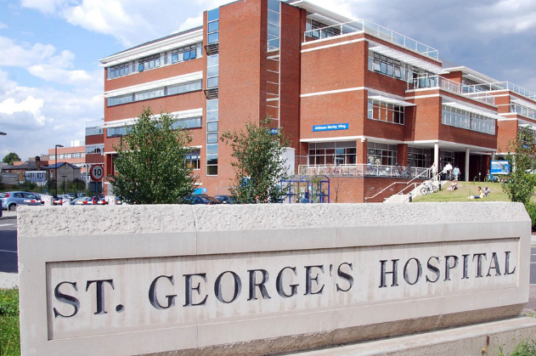

St George’s Hospital’s emergency department is no longer ‘inadequate’ say inspectors after previous breaches were found by the Care Quality Commission writes Pablo Munoz…
The Care Quality Commission (CQC) has upgraded the rating of urgent and emergency care services at St George’s Hospital, in Tooting, lifting the previous rating of ‘Inadequate’ after recognising significant improvements.
The hospital was inspected between January and February following a warning notice issued in late 2024, when breaches of Regulation 12 (failure to assess and mitigate risks), Regulation 15 (safety of premises and equipment), Regulation 17 (poor governance and record keeping) and Regulation 18 (safeguarding and staff training) were found.
The CQC previously detected these violations of the Health and Social Care Act 2008 at St George’s Hospital and gave it an ‘inadequate’ rating. This has now been raised to ‘Requires Improvement’, meaning the department is no longer labelled a safety risk and is clear of its legal breaches.
Kate Slemeck, managing director at St George’s, said: “This inspection shows the real impact of our teams’ hard work and focus on improvement.
“Our urgent and emergency care services are renowned for the life-saving and expert treatment our teams provide, and we will continue to embed new policies, documentation and digital systems, building confidence that the CQC will recognise even greater improvements in the next inspection.”
The CQC highlighted many improvements following their inspection, noting stronger systems of care that have bolstered oversight in the waiting area. This has improved patient flow and led to average wait times falling to just five minutes, which is 10 minutes faster than the national target.
The new audit also showed stronger documentation and clinical monitoring, greater access to time-critical medicines, improvements in electronic prescriptions and seven-day pharmaceutical provision, which is currently under development.
The hospital has introduced ‘tap-and-go’ logins for computers to improve security and patient safety, and has trained 94 per cent of its staff on GDPR, the data protection framework.
Relatedarticles




However, the CQC found room for improvement regarding risk assessments being fully completed for all patients, the full embedding of new safety and digital processes and pharmacy coverage, which is moving towards a full seven-day service.
The commission also found that not all staff were aware of changes to important policies and observed some patients being allowed to take medicines themselves, contrary to the trust’s self-administration policy.
The full inspection report can be found on the CQC website.